
Agar.io: Eat, Grow, and Dominate the Multiplayer Arena
Anúncios
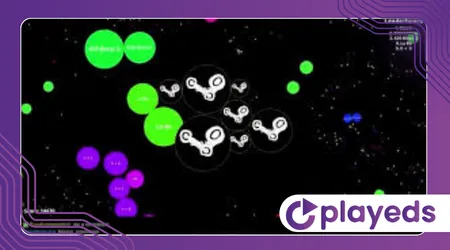
In the ruthless ecosystem of Agar.io, survival is a high-stakes calculation of mass and momentum. This minimalist titan remains a digital phenomenon in 2026, challenging players to navigate a petri dish where every cell is a predator.
Success requires more than just size; it demands tactical splitting, mastery of the virus, and the cold intuition to outmaneuver a global arena.
Summary of This Guide
- Core Mechanics: The physics of cellular consumption.
- Tactical Depth: Beyond the split-kill meta.
- Technical Edge: Eliminating the latency tax.
- Social Warfare: The complex reality of 2026 clans.
- Sustainability: Staying relevant in a shifting arena.
What is Agar.io and Why Does it Persist?
While flashy battle royales come and go, this digital petri dish survives by stripping gaming down to its most primal state: eat or be eaten.
There is something inherently honest about a game where your only identity is a circle and your only purpose is accumulation.
The appeal isn’t just nostalgia. In an era of bloated tutorials, the immediate “spawn-and-sprint” loop offers a refreshing lack of friction.
It’s a low-stakes environment that suddenly becomes high-stakes the moment you break into the top ten leaderboard.
The 2026 landscape shows a game that has matured. The community has moved past basic movement, turning a simple browser window into a stage for high-level kinetic geometry and psychological warfare.
How Does the Growth and Splitting System Work?
Growth is a double-edged sword. As you vacuum up pellets, you gain the gravity of a planet but the maneuverability of a tectonic plate. This trade-off creates a constant tension between the desire for power and the need for speed.
Pressing the spacebar is the game’s defining gamble. Splitting hurls half your mass forward like a biological missile to snag smaller prey. It’s an aggressive, satisfying move that simultaneously leaves you fractured and vulnerable to opportunistic scavengers.
Success requires a internal clock for “coalescence.” You have to know exactly when your fragmented pieces will merge back into a single unit. Miscalculate by a second, and a rival will scoop up your divided self before you can reform.
++ Slither.io: Become the Longest Snake by Outsmarting Others
Which Strategies Lead to Dominance in the Arena?
The most misunderstood element of the game is the Virus. These jagged green obstacles are usually seen as hazards, but for an expert, they are the ultimate equalizer. They are the only way a small player can topple a giant.
By “feeding” a virus with the W key, you can actually aim and fire it. Watching a massive, arrogant cell shatter into a dozen helpless fragments after a well-placed virus shot is perhaps the most rewarding experience the game offers.
There is also the “bait-and-switch.” Experienced players often pretend to be distracted or clumsy, enticing others to split-attack them, only to skillfully dodge and counter-consume the now-vulnerable aggressor.
To execute these maneuvers without the frustration of ghost-inputs, keeping an eye on official technical updates is mandatory for anyone tired of losing mass to avoidable frame drops.
Comparison of Game Modes in 2026
| Mode | Core Philosophy | Best For | Risk Level |
| FFA | Pure Darwinism | Soloists | High |
| Battle Royale | Shrinking Chaos | Fast Twitch | Extreme |
| Teams | Symbiotic Survival | Social Players | Moderate |
| Experimental | Mechanical Oddities | Tacticians | Low |
What are the Technical Requirements for Peak Performance?
Modern web standards have improved, but Agar.io is still sensitive to browser bloat. Running the game on a “clean” instance without twenty open tabs isn’t just a suggestion; it’s a competitive necessity for high-level play.
In 2026, hardware acceleration is the silent hero of the leaderboard. If your browser isn’t leveraging your GPU, those micro-stutters during a 16-way split will inevitably result in a “Game Over” screen.
Read here: Paper .io 2: Conquer Territory and Outsmart Your Online Rivals
Mobile players have it tougher. The touch-screen interface lacks the snap of a mechanical keyboard, but it offers a unique fluidity in 360-degree movement that mouse users sometimes struggle to predict in close-quarters combat.
Why is Teamwork Essential in Modern Play?
There’s a strange, unspoken diplomacy that happens in the FFA servers. Players often “W” each other as a sign of temporary peace. It’s a fragile trust that usually ends in betrayal, adding a layer of social manipulation to the physics.
Official Team Mode removes the ambiguity, turning the game into a turf war. Here, the strategy shifts toward “overlap protection,” where teammates hover near each other to discourage larger enemies from committing to a split.
++ The Impact of Games with Procedural Cat Heroes Like Mewgenics
The most advanced teams use “cross-feeding” to keep their most aggressive member at peak size. It’s a sophisticated dance of mass management that transforms the game from a casual distraction into a genuine e-sport.

When Should You Use the “Eject Mass” Function?
The W key is often used too casually by beginners. Every time you eject mass, you are literally throwing away your health. It should be treated as a strategic investment, not a greeting.
Use it to lure “greedy” cells into corners. A trail of ejected mass is like breadcrumbs for a bird; by the time they realize the trap, you’ve already split over them and reclaimed your “investment” along with their entire volume.
It’s also your primary defensive tool. If a teammate is about to be consumed, a rapid injection of mass can give them the size needed to survive the encounter or turn the tables on the attacker.
The beauty of the arena lies in its lack of a ceiling. There is no “perfect” game, only a series of increasingly difficult decisions. Whether you’re a massive entity or a tiny speck, the goal remains the same: survive the next ten seconds.
The game thrives because it taps into something fundamental. It’s a cycle of growth and loss that mirrors the chaotic unpredictability of any competitive ecosystem, all contained within a simple browser tab.
If you’re interested in the broader impact of these minimalist designs on the industry, the Internet Archive’s digital library offers a deep dive into the software evolution that allowed these massive multiplayer experiences to become global staples.
FAQ: Frequently Asked Questions
1. Is the game still receiving updates?
Yes. While the core loop is untouched, 2026 has seen various backend optimizations and seasonal cosmetic events to keep the servers fresh.
2. How do I deal with “Teaming” in Solo mode?
It’s a persistent challenge. The best counter is using Viruses to shatter one of the team members, making it too risky for their partner to stay and help.
3. Why do some players move faster than me?
Movement speed is inversely proportional to mass. The smaller you are, the faster you move. This is the only reason small cells have a fighting chance to escape.
4. Can I play offline?
No. The game relies entirely on real-time interaction with other players. However, there are “private” server tools for those looking to practice mechanics solo.
5. What is the best way to gain mass quickly?
Initially, focus on the static pellets. Once you reach roughly 200 mass, look for “split-scraps”—the tiny fragments left over after a large battle.
