
Monster Energy Supercross 6: Pilotos de élite compiten en pistas técnicas.
Anuncios
Monster Energy Supercross 6 captures the raw intensity of stadium dirt racing by refined handling mechanics, custom setup options, and high-stakes career progression.
Supercross gaming demands precise physics, split-second reaction times, and an intricate understanding of track momentum.
Whether you are mastering the rhythm sections in Houston or dialing in suspension settings for soft terrain, achieving podium finishes requires more than just holding down the throttle.
Dirt bike enthusiasts and virtual racers looking to dominate the track need actionable strategy, precise input timing, and deep mechanical insights to stay ahead of the pack.
Conclusiones clave
- Refined Physics & Handling: How line choice, weight distribution, and scrub mechanics dictate corner speed and jump arcs.
- Career Mode & Academy: Navigating coach guidance, skill tree perks, and progression systems effectively.
- Technical Track Management: Strategies for conquering rhythm sections, deep ruts, and dynamic dirt degradation.
- Pro-Level Bike Setup: Optimizing suspension, gear ratios, and brake bias for maximum traction and speed.
What Makes Monster Energy Supercross 6 the Ultimate Dirt Racing Simulation?
Digital dirt racing hinges on realism, responsiveness, and vehicle feedback. Monster Energy Supercross 6 elevates the official franchise by blending simulation-grade physics with accessible control schemes.
Developers reworked weight transfer mechanics, allowing riders to load the suspension before triple jumps or lean deep into rutted turns without losing rear-wheel traction.
Official tracks feature real-world dirt physics that deteriorate dynamically over every lap. Deep ruts form in high-traffic lines, forcing competitors to adapt their entry angles continuously.
Navigating these obstacles requires a fine balance between aggressive throttle control and precise lean adjustments.
Official riders, authentic OEM bikes, and real 2023–2026 stadium layouts bring unmatched realism to the virtual stadium.
Players experience the actual tension of the 450SX main event, facing realistic opponent AI that defends inside lines and punishes unforced errors.
How Do You Master Technical Rhythm Sections and Cornering Physics?
Speed in Supercross is not made in high-speed straights; it is forged across complex rhythm lanes and tight, bermed corners.
Understanding physics interactions transforms casual players into consistent main event contenders.
To maximize velocity through jump sections, timing is essential. Pre-loading launches the bike higher, while scrubbing flattens the arc to return tires to the ground faster.
Maintaining a backward weight bias through whoops prevents high-speed tucks and costly crashes.
Navigating Rhythm Sections Efficiently
Rhythm lanes consist of doubles, triples, whoops, and dragon’s backs. Maximizing velocity across these sections requires strategic planning rather than blind speed.
Pre-Loading Suspension: Compressing the bike’s suspension right at the base of a jump ramp launches the rider higher and further. Execute this by pulling back on the right analog stick right before takeoff.
Scrubbing for Airtime Reduction: High jumps waste precious seconds in the air.
Pushing both analog sticks inward near the lip of the jump scrubs the bike sideways, flattening the jump arc and placing tires back on the dirt faster.
++ Bassmaster Fishing 2022: Compite contra profesionales en torneos de élite.
Whoop Section Rhythm: Whoops demand steady rearward weight bias and smooth throttle modulation. Pushing forward causes the front wheel to tuck, leading to immediate crashes.
Mastering Berms, Flat Turns, and Deep Ruts
Cornering dictates whether momentum carries into the next jump sequence. Choosing the right line inside a turn decides your position on the leaderboard.
Inside Line vs. Outside Berm: Inside lines cover shorter distances but demand heavy front braking and low apex speed. Outside berms allow higher cornering speed but add distance.
Lea aquí: Descendedores: Recorre senderos peligrosos de descenso y pon a prueba tus habilidades.
Rut Navigation: Sliding into an established rut locks the bike into a stable trajectory. Enter ruts smoothly without abrupt steering inputs to maintain maximum acceleration out of the turn.
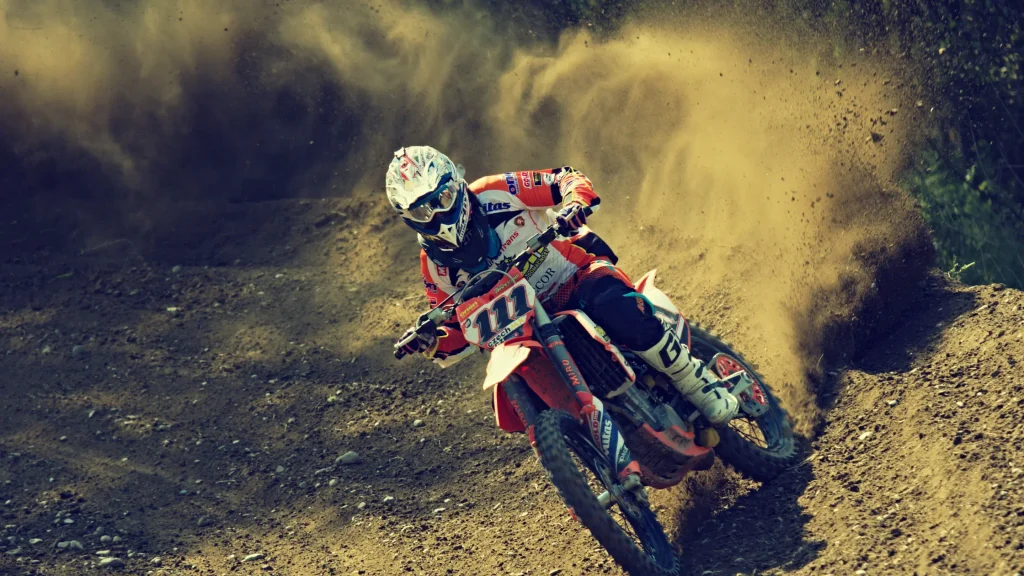
Which OEM Bikes and Official Riders Dominate the Roster?
Choosing the right machinery and observing real-world pro rider telemetry provides a distinct competitive edge.
Every manufacturer offers unique frame geometry, power curves, and handling characteristics tuned for specific riding styles.
++ Una habitación oscura: Construye tu asentamiento y descubre un mundo lleno de secretos.
Understanding the baseline stats of each brand helps players align their equipment choice with track requirements.
| Fabricante | Engine Power Bias | Handling Stability | Best Track Suitability |
| Yamaha YZ450F | High Low-End Torque | Moderate Apex Turning | Tight Stadiums, Heavy Ruts |
| Honda CRF450R | Balanced Mid-Range | Highly Responsive | Fast Rhythm Lines, Hardpack Dirt |
| KTM 450 SX-F | Broad Top-End Power | High Straight-Line Stability | Long Whoop Sections, Open Tracks |
| Kawasaki KX450 | Smooth Acceleration | Forgiving Suspension Flex | Technical Rhythm Sequences |
| Husqvarna FC 450 | Linear Power Delivery | Excellent Low-Speed Agility | Technical Arenas, Narrow Sweepers |
How Does the Supercross Academy and Skill Tree Improve Performance?
Rookie players often struggle with wild crashes and erratic bike movement.
The integrated Supercross Academy, led by racing legends, breaks down advanced mechanics into manageable, repeatable training sessions.
Official technical regulations defined by professional organizations like the American Motorcyclist Association outline chassis and engine parameters that influence the real-world physical dynamics simulated in these training modules.
Skill Progression and Attribute Allocations
Unlocking rider skills fundamentally changes bike behavior on track. Earning skill points during career events allows targeted upgrades across multiple rider attributes:
- Physical Resistance: Reduces stamina depletion during long 20-minute main events, preventing late-race control degradation.
- Scrubbing Efficiency: Increases bike responsiveness during mid-air whips, allowing lower trajectories over large jump gaps.
- Cornering Stability: Decreases the likelihood of losing traction or high-siding when carrying high speed through rutted turns.
- Whoop Control: Keeps the front wheel stable across long, aggressive whoop trails, preventing head-shake crashes.
What Are the Best Custom Tuning Setups for Maximum Traction?
Default bike setups provide balanced baseline performance, but custom tuning unlocks crucial tenths of a second per lap. Fine-tuning mechanical components shapes how power reaches the dirt.
Suspension Engineering
Suspension configuration controls how the motorcycle absorbs heavy landings and maintains tire contact through choppy rhythm sections.
Preload & Stiffness: Stiff suspension prevents bottoming out on massive triple jumps but causes harsh bouncing across whoops. Softer setups absorb rough track chatter but reduce responsiveness during quick directional changes.
Rebound Damping: Fast rebound releases suspension energy instantly, helping the rear tire track over successive bumps. Slow rebound stabilizes the chassis after heavy jump impacts.
Gear Ratios and Brake Bias
Adjusting drive ratios alters acceleration profiles to match stadium layout demands.
Short Gear Ratios: Delivers explosive acceleration out of tight turns, ideal for compact stadium tracks with short run-ups to major jump transitions.
Tall Gear Ratios: Extends top speed, allowing high-velocity runs down long start straights and open sweepers.
Brake Distribution: Shifting bias slightly toward the rear wheel allows trail-braking into turns, rotating the bike’s rear end without locking up the front tire.
Engineers and sim-racing specialists often reference chassis dynamics studies hosted by organizations like the Society of Automotive Engineers when evaluating suspension energy transfer and vehicle pitch control.
How Can Players Win the Main Event in Career Mode?
Transitioning from local qualifiers to the 450SX Championship trophy requires disciplined race management and consistent weekend execution.
To secure victory, focus on three primary phases: launch off the gate, positioning through Turn 1, and maintaining a consistent pace as track degradation creates deeper grooves in later laps.
Securing the Holeshot
Winning starts at the gate drop. Select a starting gate close to the inside edge of turn one to minimize driving distance.
Hold the clutch, rev the engine into the peak power band, and release the clutch smoothly as the gate drops. Avoid aggressive wheelies by leaning rider weight forward over the handlebars.
Managing Track Fatigue and AI Pressure
Laps eleven through twenty test focus and tactical awareness. Computer-controlled opponents attack aggressively if open gaps appear on the inside lane.
Defensive line choices along key passing zones force rivals onto slower, longer trajectories, preserving lead positions until the checkered flag drops.
Preguntas frecuentes
Is Monster Energy Supercross 6 accessible for beginners?
Yes. The game features scalable riding assists, flow-control braking options, and interactive tutorials in the Supercross Academy.
Players can adjust physics settings from casual arcade modes to full manual simulation as skill levels improve.
How does track degradation impact gameplay over long races?
As laps progress, tires carve deep ruts into corners and wear down jump lips.
Riders must constantly adjust their lines, choosing smoother secondary paths or steering clear of deep, power-sapping grooves to maintain high lap speeds.
Can bike tuning profiles be saved for specific tracks?
Yes. Custom setups for suspension, gear ratios, and brake bias can be saved in garage menus and applied before qualifiers or main events depending on track conditions.
Does weight distribution affect jumping distance?
Leaning rider weight backward during takeoff increases flight height, while leaning forward flattens jump trajectories.
Proper weight balance ensures the motorcycle lands cleanly on down-slopes rather than flat-bottoming into takeoff faces.
++ Monster Energy Supercross 6 review: subtle tweaks
++ Monster Energy Supercross – The Official Videogame 6 Review
