
Goods Sort: Organize Shelves Efficiently and Complete Every Challenge
Anúncios
Goods Sort turns crowded shelf into logic problems, asking players to recognize matches, manage limited space, and plan sequences before committing moves.
Simple controls meet increasingly demanding decisions, making each completed shelf feel earned.
For strategies, do not chase the first visible match. Study the board, protect open spaces, and prioritize moves that reveal useful items without blocking combinations.
Table of Contents
- How does the game work?
- Why does shelf management matter?
- What strategies improve performance?
- How can players avoid common mistakes?
- What does research say about puzzle games?
- FAQ
- Conclusion
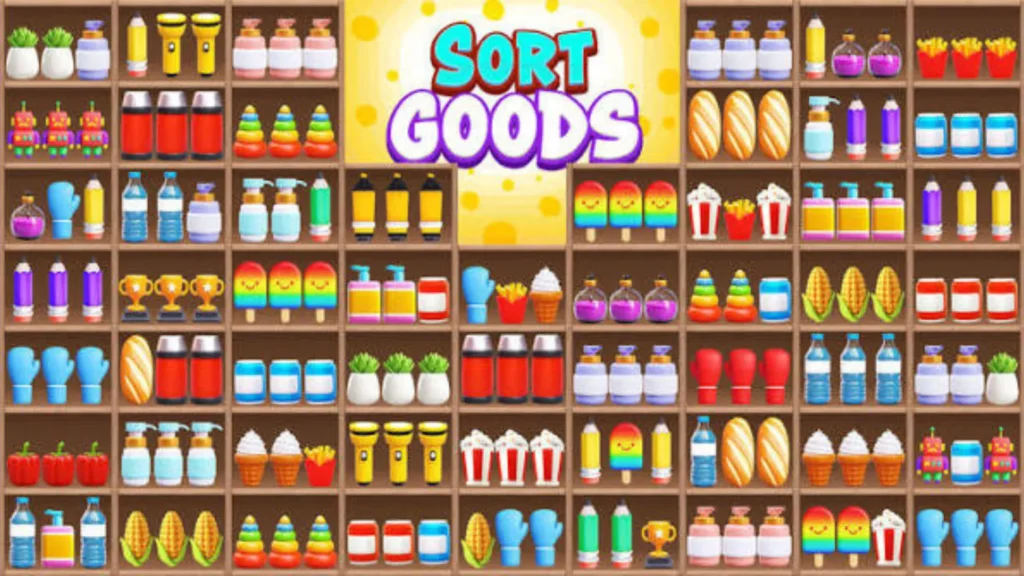
How does Goods Sort work?
Most versions use a triple-match structure: players move products onto shelves, combine three identical items, and clear matched goods.
Google Play listings describe tap-based movement and triple matching, while some versions emphasize offline play.
Although the premise looks casual, every move changes available space.
A player can create a match immediately yet damage the position by filling a shelf with unrelated products that become difficult to remove.
Start by scanning the arrangement before touching anything. Identify visible pairs, locate likely third matches, and notice which items remain buried behind front-facing products.
Once you understand those relationships, choose moves that increase options. A useful move completes a triple, exposes a product, or creates flexible shelf capacity without unnecessary clutter.
Why does shelf management matter?
Shelf capacity functions like a strategic resource. When spaces disappear, safe choices shrink, so careless placement can create a position where every available move carries avoidable risk.
Consider a board showing two identical juice bottles, one matching snack pair, and several unrelated items.
Clearing juice may expose another bottle, while moving snacks could consume the only flexible slot.
That distinction explains why immediate matches do not always represent the best decisions. Strong play considers both the current reward and the board state created afterward.
A 2026 systematic review and meta-analysis covering 133 studies and 14,245 participants found a statistically significant but small association between video-game play and several cognitive abilities.
That finding does not prove that a particular sorting game improves intelligence.
++ Outlets Rush: Expand Your Shopping Mall and Become the Ultimate Retail Tycoon
Puzzle mechanics may engage attention, memory, spatial processing, and cognitive control, but entertainment should not be marketed as clinical training.
What strategies improve performance?
Start with a full-board scan lasting several seconds. Mark obvious triples mentally, then identify pairs whose third item sits behind another product. That simple inventory prevents impulsive placements.
Next, prioritize moves that reveal information. Removing a front item can expose several possibilities, giving you more useful choices than stacking another unrelated object on an already crowded shelf.
Keep at least one flexible space whenever possible. Empty capacity acts as a buffer, allowing you to reposition products while waiting for a hidden match to appear.
When several triples exist, prefer the combination that clears the most obstructive items. A match that opens two blocked positions can outperform one that merely removes three easy products.
Use a second rule for uncertainty: postpone commitment when a move depends on a hidden item. If you cannot predict what appears underneath, preserve alternatives until clearer information appears.
Read more: Royal Kingdom: Solve Match-3 Challenges While Expanding a Beautiful Fantasy Realm
Treat boosters or special tools cautiously when a particular version offers them. Save assistance for genuinely constrained positions instead of spending resources to solve routine arrangements.
How can players avoid common mistakes?
One frequent error involves matching too quickly. Players see three identical products and clear them immediately, yet that action may remove a useful blocker while leaving awkward items exposed.
Another mistake comes from filling every available shelf space.
A visually organized board can become strategically worse when each slot contains a different product and no room remains for temporary placement.
Ignoring the back layer creates similar problems. Front items often determine access to hidden products, so clearing one shelf without considering what follows can produce an unfavorable chain reaction.
++ Mullet MadJack: Race Against Time in a Hyper-Fast Anime Shooter
Overusing hints can also weaken decision-making. Hints may solve a momentary obstacle, but learning to evaluate space, sequence, and future access provides a more transferable understanding of the puzzle.
What does current data tell us about puzzle games?
The table separates verified game facts from broader research findings, avoiding marketing claims presented as scientific outcomes when evaluating casual games.
| Measure | Verified finding | Practical meaning |
|---|---|---|
| 2026 review scope | 133 studies; 14,245 participants | Large evidence base, but mixed game types |
| Cognitive association | Statistically significant, small | Possible benefit, not proof of causation |
| Commonly examined domains | Memory, spatial ability, visual attention, cognitive control | Relevant to puzzle mechanics |
| Game-specific evidence | No clinical proof for Goods Sort | Treat it primarily as entertainment |
The 2026 meta-analysis reported small associations across memory, spatial ability, visual attention, cognitive control, and intelligence.
These results support cautious optimism, not sweeping brain-enhancement claims.
For deeper context, readers can consult the 2026 systematic review in PubMed, which explains its methods, participant pool, effect estimates, and limitations.
How can you improve efficiency on difficult levels?
Efficiency improves when you think in sequences rather than isolated moves. Before placing an item, ask what the shelf will look like after the match clears and what new access that creates.
A sequence might begin with a pair, use an open shelf for storage, reveal the third item, and then clear the triple. Order matters because space remains limited throughout.
If two choices appear equally safe, select the move that reveals more hidden products. Information has strategic value because every exposed item can change the next available combination.
When a level feels impossible, stop repeating the same pattern. Reset your mental model, inspect the board again, and search for a dependency explaining why previous attempts failed.
FAQ
Is Goods Sort easy to learn?
Yes. The basic triple-match rule requires little explanation, but later layouts demand planning because shelf capacity, hidden products, and move order interact continuously.
Does Goods Sort improve memory?
Evidence on video games suggests small associations with several cognitive abilities, including memory, but research does not establish that Goods Sort produces measurable long-term improvements.
What is the best first move?
Choose a move that either completes a safe triple or exposes useful information. Avoid filling flexible spaces when you cannot predict the resulting board.
Can I play without internet access?
Availability depends on the specific version. One current Google Play listing explicitly advertises offline play, so players should check the individual app description before relying on that feature.
Conclusion
Successful shelf sorting rewards restraint more than speed. Scan first, protect flexible capacity, expose hidden products, and select matches according to the opportunities they create afterward.
Evidence also encourages realistic expectations. Puzzle games can provide engaging mental challenges, while current research suggests modest cognitive associations across game play generally; it does not justify medical or therapeutic promises.
For practical guidance on healthy digital habits, the National Institutes of Health provides authoritative health information that can complement responsible gaming choices.
Approach every level as a planning exercise rather than a race.
With deliberate scanning, controlled space management, and smarter sequencing, you can organize shelves efficiently and tackle challenges confidently.
++ Goods Triple Sort Strategy Guide: Master Shelf Organization and Match-3 Tactics
++ Goods Puzzle: Sort Challenge – Walkthrough
