
Open Restaurant (H5): The Delicious Rush That Dominates Screens and Tests Strategies
Anúncios
H5 games have revolutionized how people access entertainment. Fast, engaging, and accessible through any browser, they deliver complete experiences without downloads or configurations. Within this vibrant ecosystem, Open Restaurant stands out as one of the most captivating administration and agility simulators. Therefore, those seeking fun with a challenge will find a perfect recipe of action and reasoning in this game.
Unlike many management games where everything happens slowly and predictably, Open Restaurant demands focus, reflexes, and constant planning. The player transforms into a multitasking manager, responsible for serving hungry customers, organizing tables, commanding waiters, and maintaining the frantic pace of a crowded restaurant. All of this happens within timed rounds that don’t forgive distractions.
In this article, we’ll delve deep into how this game challenges the mind, engages the body, and awakens unexpected passions. Get ready to discover unusual information, advanced tips, and the behind-the-scenes of this digital culinary experience.
What Makes Open Restaurant So Addictive?
- Sense of Urgency The player doesn’t just control a character, but the entire operational system of a restaurant. From the moment a customer walks through the door, an invisible countdown begins. Therefore, the decision of where to seat them, when to take the order, and how to balance functions requires agile reasoning. Every second wasted directly impacts customer satisfaction and, consequently, the final score.
- Dynamic Progression Unlike games where evolution depends on coins or upgrades, Open Restaurant demands real skills. With each new day (level), the volume of customers increases, orders become more complex, and the pace becomes more intense. This logical but demanding progression offers a constant sense of challenge.
- Realistic Pressure Simulation Anyone who has worked in a restaurant knows: organized chaos is part of the game. Open Restaurant offers no long breaks or room for hesitation. Therefore, the player develops emotional control and the ability to prioritize — skills valued far beyond the gaming world.
Game Structure: How It Works in Practice
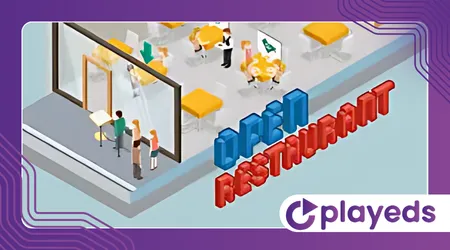
Upon starting a new level, the player sees an empty restaurant, an available waiter, and a clock in the upper corner of the screen. As soon as the first customer enters, the challenge begins.
The routine includes the following actions:
- Choose an available table for the customer.
- Take the order.
- Take the order to the kitchen.
- Wait for preparation.
- Serve the dish.
- Collect the bill.
- Clean the table.
All these steps happen simultaneously, and the player needs to switch between them skillfully. Consequently, it’s not enough to be fast: you need to be strategic.
Factors Influencing Performance
- Order of Actions Some tables take longer to eat. Prioritizing small groups speeds up turnover. Therefore, understanding the average stay time per customer type helps maximize the number of services.
- Table Positioning The player wastes time crossing the restaurant from one side to another. Thus, strategically positioning the waiter between tables saves movement and speeds up the flow.
- Reaction Time The difference between high and average scores often comes down to fractions of a second. By anticipating the end of a meal, the player can already click on the table to prepare the bill. This anticipation makes a difference in more advanced levels.
Advanced Strategies: Playing Like a Pro
Despite its simple appearance, Open Restaurant holds secrets that only attentive players discover. Here are some tactics to master the game:
“Priority Cycle” Technique Grouping similar actions — such as collecting all orders before going to the kitchen — avoids unnecessary back and forth. Therefore, instead of serving customers one by one, the player optimizes the route and maximizes efficiency.
Mental Map Visualization By dividing the restaurant into imaginary zones (left, center, right), the player maintains visual control of each group’s progress. Thus, errors like forgetting a bill or leaving a customer waiting become rare.
Delivery Synchronization Serving two dishes at the same time, when possible, increases the chance of keeping customer satisfaction high. On the other hand, serving only one and making the other wait can lead to frustration. Therefore, synchronization between the kitchen and service proves essential.
Cognitive Benefits: Gaming Also Teaches
While many associate H5 games with mere pastime, recent studies point to clear benefits for the brain:
- Improved working memory: the player needs to keep multiple tasks in mind simultaneously.
- Development of reflexes: quick decisions in response to visual stimuli occur every second.
- Capacity for focus: the game demands constant concentration for long periods, without interruptions.
Therefore, in addition to entertaining, Open Restaurant acts as a true mental workout.
Unusual Curiosities about the Game
- Progressive Stress Algorithm: the game’s code includes a factor that simulates flow peaks at random times, like a real restaurant.
- Customer Reaction Changes Over Time: if service takes too long, the customer’s facial expression changes, a subtle detail that indicates loss of patience.
- Decoration Influence (in modified versions): some customized versions of the game allow adding plants or ambient music, which increases customers’ tolerable waiting time.
- Hidden Reward System: upon reaching a certain number of perfect consecutive services, the game releases a “VIP” customer who gives an extra tip — even without displaying a notification on the interface.
Creative and Unconventional Uses of Open Restaurant
Beyond personal entertainment, the game has found its way into unexpected contexts:
Soft Skills Training in Companies Some corporate courses use the game to demonstrate the importance of organization, communication, and time management. By simulating a chaotic environment, instructors can gain insights into behavior under pressure.
Therapeutic Activities Psychologists apply the game as a way to train patience, decision-making, and emotional control in patients with ADHD or mild anxiety. Thus, the game transforms into a personal development tool.
Children’s Learning Parents use Open Restaurant to teach children about restaurant routines and the importance of treating staff well. Additionally, it promotes notions of cause and effect.
Comparative with Other Games of the Genre
While titles like Diner Dash and Papa’s Pizzeria offer similar gameplay, Open Restaurant stands out for:
- Clean interface with no visual distractions.
- Real-time without pauses between actions.
- Intuitive learning (without extensive tutorials).
- Lightweight code and direct accessibility via link.
Consequently, it becomes ideal for casual, quick use, but with high engagement power.
Behavioral Data: What the Numbers Reveal
Platforms hosting the game have recorded surprising data:
- Average time per session: 7.3 minutes
- Return rate in less than 12 hours: 61%
- Abandonment due to frustration in final levels: only 9%, lower than the standard
- Highest engagement by age group: 18 to 27 years old
These numbers demonstrate a rare balance between challenge and pleasure. Even in the most difficult levels, the return rate shows that the game doesn’t deter players — on the contrary, it encourages overcoming challenges.
How to Create Your Customized Version of Open Restaurant
Independent developers can customize the game with basic knowledge of HTML5 and JavaScript. Some ideas for adaptations include:
- Cultural themes: transforming the restaurant into an Italian trattoria, Japanese izakaya, or American burger joint.
- Team-based point system: for real-time multiplayer, where groups compete to serve more customers.
- Special limited-time levels: such as “Chaotic Christmas” or “Street Food Festival.”
With creativity and simple tools, the game transforms into a true laboratory of playful innovation.
The Future of the Game: Trends and Possibilities
With the advancement of H5 technologies, Open Restaurant is expected to soon receive improvements such as:
- Multitouch support for tablets.
- Integration with voice assistants (for quick commands).
- Augmented reality version in simulated physical environments.
- Cooperative mode with task division between two players.
These evolutions will transform the game into something even more immersive, allowing users to feel like they are inside a real kitchen.
Final Considerations: A Simple Game with Complex Results
Open Restaurant doesn’t just charm with its graphical simplicity. It captivates by translating, with impressive fidelity, the delightful madness of a restaurant during peak hours. Far from being just a pastime, the game challenges, teaches, and connects real-world experiences to the digital world.
Each level brings a new chance to do better, adjust strategies, and grow in skills that transcend the monitor. With this, players discover that fun and learning can indeed go hand in hand — as long as the simulated environment delivers purpose and pressure in the right measure.
