
Outer Wilds: Travel Through Time and Solve Cosmic Mysteries
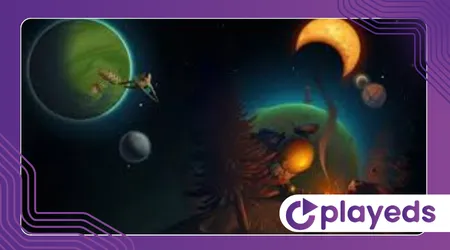
Outer Wilds represents the pinnacle of modern environmental storytelling, challenging players to explore a hand-crafted solar system trapped in a perpetual twenty-two-minute time loop.
Anúncios
This masterpiece by Mobius Digital transcends traditional gaming tropes by replacing standard progression systems with pure, unadulterated curiosity and the pursuit of scientific knowledge.
In this comprehensive guide, we examine why this indie phenomenon remains a definitive benchmark for the adventure genre in 2025.
Summary
- The Loop Mechanic: Understanding the temporal heart of the game.
- Curiosity-Driven Exploration: Why knowledge is your only permanent upgrade.
- Cosmic Archaeology: Piecing together the tragic history of the Nomai.
- Physics and Realism: The impressive technical foundation of the solar system.
- The 2025 Perspective: How the game influences current adventure design.
What is Outer Wilds and Why is it Unique?
At its core, Outer Wilds is an open-world mystery where the primary obstacle is your own lack of information rather than physical barriers or locked doors.
You play as the newest recruit of Outer Wilds Ventures, a modest space program established by the rustic, four-eyed inhabitants of Timber Hearth.
Unlike most contemporary titles that rely on skill trees or gear, every location in this solar system is accessible from the very first minute of gameplay.
Your ability to reach these areas depends entirely on your understanding of the physical laws and environmental patterns governing each unique planet.
The brilliance of Outer Wilds lies in its “Metroidbrainia” design, where the only thing preventing progress is a lack of conceptual understanding regarding the world’s complex mechanics.
This creates a deeply personal sense of accomplishment as you slowly decipher the cryptic messages left behind by an ancient race.
How Does the Time Loop Function in Gameplay?
The central mechanic of Outer Wilds is a recurring twenty-two-minute window that ends with the local star going supernova and consuming everything in its path.
Upon death, your memories are transmitted back to the start of the loop, allowing you to retain every discovery made during your previous run.
This cycle creates a unique narrative urgency, forcing you to prioritize specific tasks while managing the shifting topography of planets that evolve or crumble in real-time.
You might find a hidden city on Brittle Hollow before it falls into a black hole or enter a cave before it fills with sand.
Read more: Subnautica
By utilizing the ship’s computer to track “Rumors,” Outer Wilds ensures that players never feel truly lost despite the non-linear structure of the cosmic investigation.
This digital log acts as a detective’s corkboard, connecting disparate clues into a coherent map of the ancient past.
Why is Knowledge the Only Form of Progression?
In Outer Wilds, you do not gain experience points, better armor, or faster engines; instead, you gain a deeper perspective on how the universe actually functions.
Every discovery acts as a key that unlocks a mental door, allowing you to bypass hazards that previously seemed completely impassable or deadly.
This design philosophy respects the player’s intelligence by assuming they will eventually connect the dots between a mural on one planet and a mechanism on another.
The game fosters a genuine “Eureka!” moment that few other titles can replicate, making every small breakthrough feel like a monumental victory.
To understand the scope of the solar system, consider the following technical and environmental data points that define the various celestial bodies you will encounter during your journey:
Solar System Overview
| Planet/Body | Primary Hazard | Key Environmental Feature |
| Timber Hearth | Geysers | Home base with peaceful, rustic atmosphere. |
| Giant’s Deep | Cyclones | Gas giant with islands tossed into space. |
| Brittle Hollow | Black Hole | Crumbling crust falling into a central void. |
| Ember Twin | Rising Sand | Interconnected caves that flood over time. |
| Dark Bramble | Fog & Predators | Non-Euclidean space filled with lethal life. |
Which Scientific Concepts Drive the Narrative?
The developers integrated authentic astronomical concepts into Outer Wilds, such as orbital mechanics, quantum uncertainty, and special relativity, to create a believable and immersive sandbox.
These aren’t just background fluff; they are active gameplay elements that players must master to reach the game’s emotional conclusion.
++ Elden Ring
Quantum objects in the game only stay in one position while being observed, a direct nod to the observer effect in physics.
Learning to manipulate these properties is essential for reaching the most secluded areas of the solar system, requiring the player to think like a scientist.
For those interested in the real-world physics that inspired these mechanics, NASA provides excellent context for how gravity and momentum dictate travel in a vacuum. Understanding these forces makes navigating the ship much more intuitive.
What Are the Nomai and Their Legacy? Outer Wilds
The Nomai were a nomadic, technologically advanced race that inhabited the solar system thousands of years before the events of Outer Wilds began.
Their story is told through translated spirals of text found in ruins, revealing their scientific ambition and their deep philosophical curiosity.
Read here: Just Cause 4
As you uncover their writings, you realize they weren’t just colonizers, but seekers of a specific cosmic signal known as the Eye of the Universe.
Their tragic failures and ultimate sacrifices provide the emotional backbone of the game, turning a lonely exploration into a poignant conversation across time.
The relationship between the player and the Nomai is one of intellectual kinship, as you follow in their footsteps to complete a mission they started eons ago.
This connection transforms the search for answers into a duty to honor those who came before you in the stars.
When Should You Play the Echoes of the Eye DLC?
The expansion, Echoes of the Eye, seamlessly integrates into the existing world of Outer Wilds, adding a massive new location that challenges your perception of the story.
It introduces more traditional “horror” elements and light-based puzzles that contrast beautifully with the bright, physics-based puzzles of the base game.
Most veterans suggest playing the DLC after you have a firm grasp of the main narrative but before you trigger the final sequence.
This ensures the additional context provided by the expansion enhances the weight of the ending, making the entire experience feel more complete and resonant.
The DLC proves that the “knowledge-as-progression” model can work even within a more contained, atmospheric setting.
It expands the lore in a way that feels essential rather than tacked on, proving the enduring versatility of the game’s core design principles.

The Enduring Impact of a Cosmic Journey Outer Wilds
Few experiences in any medium capture the bittersweet nature of discovery as effectively as Outer Wilds. It is a game about the joy of learning, the inevitability of change, and the importance of looking at the stars one last time before the light fades.
By the time you reach the credits, your perspective on the universe will likely have shifted, leaving you with a profound appreciation for the interconnectedness of all things.
It remains a mandatory experience for anyone who values storytelling, atmosphere, and the pure thrill of the unknown.
If you are looking for more information on how indie titles are pushing the boundaries of interactive narratives, check out The Game Awards archives to see how this title has influenced a generation of developers.
Frequently Asked Questions
Is Outer Wilds a horror game?
While it contains some tense moments and a sense of cosmic dread, it is primarily an exploration and mystery game focused on curiosity.
Can I play with a mouse and keyboard?
Yes, though the developers highly recommend using a controller for more precise control over your ship’s thrusters during complex orbital maneuvers.
How long does it take to beat?
A typical first playthrough takes between 15 and 25 hours, depending on how quickly you piece together the various clues and hidden locations.
Is there combat in the game?
No, there is no traditional combat; your only tools are a signalscope, a scout camera, and your own ability to observe and learn.
Does the game have multiple endings?
There are several “minor” endings based on specific actions, but there is one definitive, intended conclusion that resolves the overarching mystery.
++ Learning to Have the Heart of an Explorer in Outer Wilds
