
O Escudeiro Corajoso: Salte entre as Páginas dos Livros de Histórias e os Mundos 3D
Anúncios
The Plucky Squire, developed by All Possible Futures and published by Devolver Digital, is precisely that kind of release.
Action-adventure games often rely on mechanics that feel comfortable and familiar.
Every few years, however, a title breaks through that completely redefines visual storytelling and environmental interaction.
By seamlessly bridging the gap between flat 2D illustration and realistic 3D environments, this title delivers a masterclass in modern game design.
Jot, a heroic storybook character, gets kicked out of his own book by the villainous Humgrump, forcing him to navigate both a colorful realm of paper and the vast physical world of a child’s bedroom.
Principais conclusões
- Dimension-Hopping Mechanics: How page-jumping transitions between 2D paper artwork and 3D tabletop spaces.
- Environmental Puzzle Solving: Creative use of words, stamps, and physical objects to manipulate the storybook’s narrative.
- Genre-Bending Gameplay: Dynamic homage to classic genres, including rhythm games, arcade beat-’em-ups, and turn-based battles.
- E-E-A-T Performance Breakdown: Technical stability, visual design achievements, and pacing across platform releases.
What Makes The Plucky Squire’s Dimensional Mechanics So Unique?
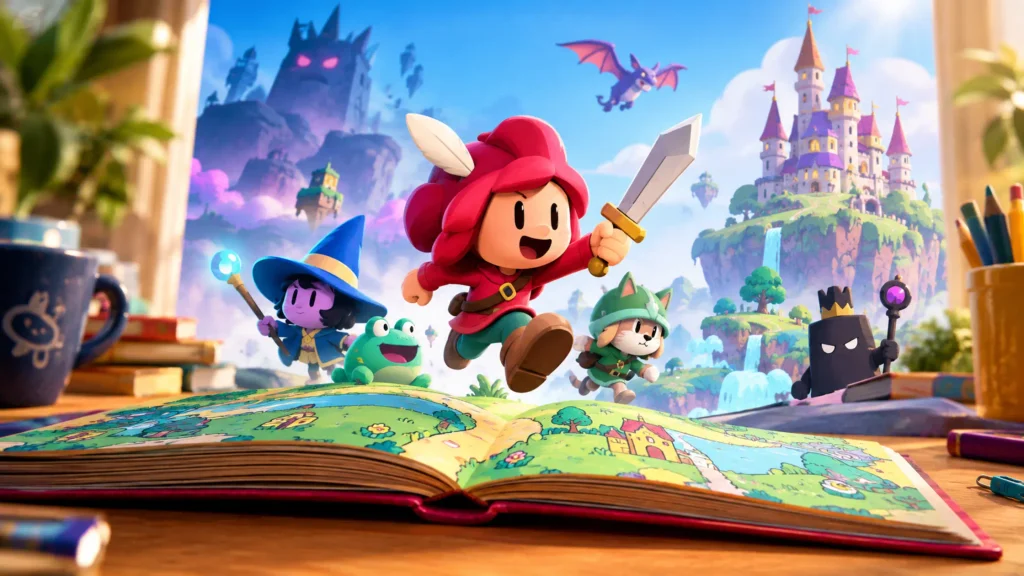
O principal atrativo de The Plucky Squire lies in its fluid transition between two entirely distinct visual dimensions.
Traditional platformers keep players locked within set boundaries, but Jot’s adventure turns spatial limitations into a primary gameplay tool.
When Jot encounters an impassable barrier on the flat page, he can exit the book through magical green portals scattered across the artwork.
Stepping outside places him on a sprawling, three-dimensional study desk surrounded by oversized mugs, art supplies, and cardboard castles.
Manipulating the physical world directly impacts what happens inside the book.
Jot might venture across the desk to retrieve a stray stamp, alter an obstacle in 3D, and jump back into the page to find his path cleared.
These shifts feel instantaneous, eliminating jarring load screens.
The dynamic contrast between vibrant 2D ink drawings and soft 3D lighting creates constant visual surprise, keeping the exploration fresh throughout its eight-to-ten-hour campaign.
How Does Narrative Manipulation Drive Environmental Puzzles?
Puzzles in The Plucky Squire go far beyond flipping switches or moving heavy blocks. Instead, players physically alter the written words printed on the storybook pages to rewrite reality.
A giant block of cheese might obstruct your path, described in the text as “a huge block of cheese.”
++ Neva: Viaje por um mundo moribundo com um lobo leal como companheiro.
By striking the bold word “huge” with your sword, you can pop it out of the sentence structure. Inserting the word “tiny” instead instantly shrinks the obstacle, allowing Jot to slip past.
Dica profissional: Keep track of descriptive words across adjacent pages. Sentence components can often be carried between different spreads to solve complex environmental blockades.
As you progress, the game introduces additional tools:
The Tilt Gauntlets: Allow players to physically grab the storybook pages and tilt the entire book to slide heavy objects across the room.
The Stop Stamp: Freezes moving hazards or enemies in place within the 2D plane.
The Bomb Stamp: Destroys cracked wooden crates and path obstructions both inside and outside the book.
These mechanics turn the game world into an interactive narrative sandbox. You do not just read the story—you edit, rearrange, and reconstruct it to overcome obstacles.
++ Tchia: Navegue, escale e dê um salto de alma por um paraíso tropical
Gameplay Comparison: 2D Storybook vs. 3D World
To understand how The Plucky Squire balances its dual perspectives, examine how core mechanics adapt depending on your current dimension:
| Elemento de jogabilidade | 2D Storybook Dimension | 3D Bedroom Realm |
| Perspective | Top-down and classic side-scrolling | Full 3D third-person exploration |
| Estilo de combate | Light sword combos, spin attacks, throwing arcs | Platforming, stealth, and spatial puzzle-solving |
| Puzzles | Word manipulation, block pushing | Object retrieval, tilt mechanics, stamp usage |
| Visual Art Style | Vibrant, hand-drawn vector and ink illustrations | Realistic rendered textures, dynamic tilt-shift lighting |
| Unique Challenges | Mini-game tributes (Rhythm, Punch-Out) | Stealth sequences among desk clutter and toys |
Why Is Genre Diversity Central to the Adventure?
Beyond its headline dimensional mechanic, The Plucky Squire continuously shifts genres to match the story’s emotional beats.
Rather than sticking strictly to action-adventure norms, the developers incorporate nostalgic tributes to gaming history.
Leia mais: Woodoku: Combine Sudoku e Quebra-Cabeças de Blocos em um Desafio Viciante
When Jot encounters a dragon character, the game transitions into a side-scrolling arcade boxing match reminiscent of Punch-Out!!.
Meeting a musical elf triggers a guitar-hero-style rhythm sequence where precise timing determines your victory.
Other sections transform the action into turn-based RPG encounters, bubble-shooter puzzles, or vertical shoot-’em-up sequences across coffee mugs.
These variations break up combat routines, ensuring that gameplay remains unpredictable.
Each genre shift serves the narrative naturally. Instead of feeling like disconnected mini-games, these moments emphasize the whimsical imagination of a child’s bedroom play session.
For broader context on how narrative design shapes modern indie games, explore the industry analysis on Desenvolvedor de jogos, which tracks creative trends across independent studios.
What Tech Performance Can You Expect Across Platforms?
Visual charm requires solid technical execution under the hood.
The Plucky Squire runs on Unreal Engine 4, smoothly transitioning from 2D vector rendering to a full dynamic depth-of-field 3D pipeline.
PlayStation 5 & Xbox Series X: Target a stable 60 frames per second at native 4K resolution. Load times during dimensional transitions are virtually instantaneous thanks to high-speed solid-state storage.
PC Performance: Offers extensive scalar options for shadow quality, ambient occlusion, and texture resolution. A mid-range graphics card handles max settings comfortably.
Nintendo Switch: Runs capably, though resolution scales dynamically to preserve performance during complex 3D scenes. Frame rates drop occasionally during heavy particle effects on desk surfaces.
Audio design deserves equal praise. The orchestral soundtrack adapts dynamically as you shift dimensions, muting into softer, muffled tones inside paper pages and expanding into full stereo reverb when stepping out onto the desk.
Perguntas frequentes
Is The Plucky Squire suitable for younger players?
Yes, the game carries an E for Everyone rating. Its puzzle design encourages critical thinking through wordplay, making it accessible and engaging for players of all ages while offering charming nostalgia for adults.
How long does it take to complete the main story?
A standard playthrough takes roughly 8 to 10 hours. Completing all optional achievements, collecting hidden art scrolls, and unlocking fully upgraded sword abilities extends playtime to around 12 hours.
Can you replay individual chapters after finishing the game?
Yes, the main menu features a dedicated Chapter Select option. This feature allows players to go back and collect any missed art scrolls or re-experience specific mini-game boss battles without starting a new save file.
Final Thoughts: A Love Letter to Creative Imagination
The Plucky Squire stands out as one of the most inventive indie releases in recent memory.
By turning the physical book into a playable mechanism, All Possible Futures delivers a memorable journey that honors the joy of childhood reading and play.
Whether you enjoy clever puzzle design, charming artistic direction, or nostalgic genre mashups, Jot’s adventure provides a refreshing reminder of how playful video game design can be.
Grab your sword, flip the page, and step outside the margins. To learn more about software ratings and age appropriateness for family gaming, review official guidelines provided by the Entertainment Software Rating Board.
++ The Plucky Squire: From Pokémon to a page-turning indie hit
++ The Plucky Squire: The First 26 Minutes of Gameplay (4K, 60fps)
.
