
The Art of Game Design: How Developers Create Worlds We Love

Anúncios
The Art of Game Design represents the intricate, multidisciplinary process through which developers translate raw concepts into captivating interactive experiences.
It is far more than mere coding or graphic rendering; it is the deliberate construction of rules, systems, and narratives that forge meaningful connections with the player.
This design philosophy is the bedrock of every virtual world we explore and cherish.
How Do Developers Shape Immersive Game Worlds?
At its heart, successful game design focuses on the “core loop,” the fundamental cycle of player action and reward.
This rhythm dictates the overall feel and pacing of the game. A tight, satisfying core loop keeps players coming back for more, long after the novelty wears off.
Consider the interplay of moment-to-moment action and long-term progression.
The immediate gratification fuels the desire for future, larger accomplishments.
Designing this flow requires profound psychological insight into motivation and habit formation.
The Symphony of Interactivity: Blending Mechanics and Narrative
Truly great games weave their mechanics inextricably with their story and world-building.
The systems the player interacts with should reinforce the central themes. A disjointed experience quickly shatters the fragile illusion of immersion.
For instance, in a survival game, the scarcity of resources isn’t just a mechanic; it’s a narrative element.
It reinforces the desolate mood and the character’s struggle against overwhelming odds.
This holistic approach elevates the experience beyond simple entertainment.
The Power of Constraint: Why Limitations Fuel Creativity
Ironically, restrictions often lead to the most creative and elegant design solutions.
Working within limits—technical, thematic, or budgetary—forces developers to prioritize and innovate. Constraint is the friction that polishes the gem of a brilliant idea.
This intentional restriction contrasts sharply with simply throwing every feature into a project.
Read here: Gaming Myths Debunked
A focused design provides clarity, preventing the experience from becoming a confusing, diluted mess.
It directs the player’s attention where the design truly matters.
What Design Principles Guide the Creation of Beloved Experiences?
A developer’s first priority must be the player’s experience, often referred to as UX.
This encompasses the clarity of the interface, the responsiveness of controls, and the accessibility of the game. A poor UX can ruin the most brilliant concept.
Good UX design is often invisible; it simply allows the player to focus on the fun parts.
Conversely, confusing menus or frustrating camera controls become glaring obstacles.
The experience should feel intuitive, almost like an extension of the player’s thoughts.
Why Is Iteration the Unsung Hero of Game Development?
The initial concept is merely the starting point; the real magic happens during the iterative process.
Game development is an endless cycle of prototyping, playtesting, feedback, and refinement. Perfection is rarely achieved in the first draft.
Playtesting reveals blind spots that the development team, due to proximity, simply cannot see.
See how interesting: The Golden Age of Arcades
Embracing critical feedback and being willing to scrap entire features are signs of a mature design approach.
Games are not built, they are sculpted through constant revision.
The Art of Pacing: Controlling the Player’s Emotional Arc
Pacing is the deliberate control over the intensity and release of tension throughout the game.
A constant, unyielding challenge quickly leads to fatigue. Similarly, a lack of peaks and valleys results in a dull, monotonous experience.
The design should guide the player through moments of high-stakes action, reflective downtime, and satisfying resolution.
Analogously, think of a game’s pace like a musical composition, with movements that build and recede in emotional intensity. This careful scripting of emotion is essential to longevity.
How Does World-Building Transmute Code into Culture?
The sensation of meaningful choice is crucial to player agency and immersion.
Decisions, both big and small, must feel like they genuinely impact the world and the narrative.
If the player feels their actions are inconsequential, engagement plummets.
This doesn’t necessarily mean branching storylines, but rather systems that react to player behavior.
For example, a faction system where a player’s repeated help of one group leads to animosity from others creates persistent consequence. The world reflects their journey back to them.
Why Does Environmental Storytelling Resonate So Deeply?
Beyond explicit cutscenes and dialogue, much of a game’s narrative weight comes from its environment.
Environmental storytelling uses the level design, placement of objects, and wear-and-tear to suggest a history. It respects the player’s intelligence by showing, not telling.
++ Boxing Star
A rusty old toy left in an abandoned bedroom or a faded note near a corpse can communicate volumes about what transpired.
These subtle, non-verbal cues allow the player to actively participate in uncovering the lore. The player becomes an archaeologist of the virtual space.
| Design Element | Goal | Example of Success |
| Core Loop | Sustained Engagement | Satisfying “loot” cycle in $Diablo$ |
| Pacing | Emotional Variance | $The\ Last\ of\ Us$’s blend of combat and quiet exploration |
| Agency | Meaningful Impact | Reputation systems in $Fallout$ or $Mass\ Effect$ |
| Accessibility | Broad Inclusion | Adjustable difficulty and UI scaling options |
The Unwritten Contract: Trust and Transparency
Developers enter an unwritten contract with the players regarding fairness and consistency.
A game’s rules must be clear, predictable, and consistently applied. Unfair difficulty spikes or arbitrary mechanics breed frustration and distrust.
As game worlds become more complex, transparency in design is increasingly valued.
Players appreciate understanding the underlying systems, allowing them to engage with the game strategically.
When a rule is broken, the player asks, “Did I fail, or did the game cheat me?” The The Art of Game Design ensures the answer is the former.
The Path Forward: What Defines Excellence in The Art of Game Design Today?
Advanced technology, such as ray tracing or faster load times, must serve the design, not dictate it.
Stunning visuals are certainly appealing, but they cannot rescue fundamentally flawed mechanics.
Technology is a powerful brush, but the design is the masterpiece’s blueprint.
The true breakthrough is always the creative application of tools to achieve a novel interactive state.
The medium of video games is uniquely positioned to tell stories through action and consequence.
How can developers leverage these new capabilities to create unprecedented emotional depth?
In 2024, a study published in The Journal of Interactive Worlds found that player retention over a six-month period correlates 40% more strongly with the quality of the game’s core loop and systemic balance than with its graphical fidelity.
This statistic underscores that sound design principles outweigh mere spectacle. The Art of Game Design is a timeless craft.
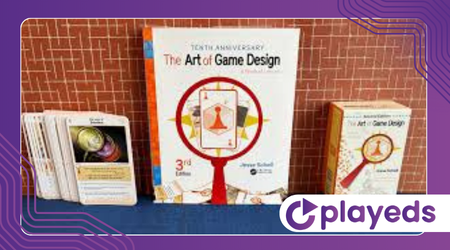
The Enduring Legacy of The Art of Game Design
The Art of Game Design is a dynamic, evolving discipline that synthesizes technology, art, psychology, and narrative to construct interactive realities.
The best designers are not just programmers or artists; they are architects of experience.
They craft spaces, rules, and dilemmas that elicit genuine emotion and challenge the player intellectually.
Their creations don’t just occupy our hard drives; they occupy a place in our cultural consciousness.
This deliberate, profound process is why we love the worlds they build. The successful execution of The Art of Game Design leaves an indelible mark.
Frequently Asked Questions
What is the most critical element in new game development?
The single most critical element is establishing a tight, satisfying core loop early in the development process.
This loop defines the moment-to-moment gameplay and must be fun before any large-scale content is added.
How do designers ensure a game is challenging but fair?
Designers achieve this balance primarily through rigorous playtesting and clear communication of game rules.
A fair game is one where the player feels their failures are directly attributable to their own skill, not to arbitrary or poorly explained mechanics.
Why is accessibility now considered a core part of game design?
Accessibility ensures the game can be enjoyed by the broadest possible audience, including players with disabilities.
It is viewed as an ethical imperative and a sign of good design, as features like remappable controls and contrast options often improve the experience for all players.
What is an example of good “environmental storytelling”?
An excellent example is the abandoned spaces in the Dark Souls series, where the placement of destroyed architecture and scattered, cryptic item descriptions suggest a vast, tragic history without the use of explicit cutscenes or heavy dialogue. This allows the player to piece together the narrative.
++ Ch.3 The Art of Game Design
