
The Chaotic Development of Duke Nukem Forever and its Record Delays
Anúncios
The gaming industry has witnessed numerous instances of prolonged game development, but few have been as notorious as Duke Nukem Forever. Initially announced in 1997, the game’s release was delayed multiple times, leaving fans in anticipation for years.
The infamous delays in the game’s development not only tested the patience of gamers but also became a symbol of the challenges faced by the gaming industry. The story of Duke Nukem Forever is a complex mix of ambitious game design, technological hurdles, and the pressures of meeting gamer expectations.
Key Takeaways
- The development of Duke Nukem Forever was marked by significant delays.
- The game’s development issues reflect broader challenges in the gaming industry.
- Fan anticipation and expectations played a crucial role in the game’s development saga.
- The game’s story is a mix of ambitious design and technological challenges.
- Duke Nukem Forever’s development became a symbol of game development woes.
The Legacy of Duke Nukem: Setting the Stage
The original Duke Nukem game left an indelible mark on the gaming world, setting the stage for a sequel that would take the industry by storm. Released in the 90s, it became a cultural phenomenon, known for its humor, action, and memorable characters.
The success of Duke Nukem created high expectations for its sequel, Duke Nukem Forever. The anticipation was palpable, with gamers eagerly awaiting a game that would live up to, or even surpass, the original’s glory. However, as the years passed, Duke Nukem Forever became synonymous with vaporware game status, a project that seemed perpetually on the horizon but never actually arrived.
The journey of Duke Nukem Forever from announcement to release is a classic example of game development hell. The sequel’s prolonged development was marked by numerous delays, changes in development teams, and shifts in technology.
- Initial hype and anticipation
- Prolonged development period
- Multiple delays and changes in development strategy
These factors contributed to the game’s infamous status and raised questions about its eventual release. Despite the challenges, the legacy of Duke Nukem endured, maintaining a loyal fan base that held out hope for a worthy sequel.
The Initial Announcement:1997’s Bold Promise
With great anticipation, 3D Realms unveiled Duke Nukem Forever in 1997, setting the stage for what would become one of the longest game development stories in gaming history. The announcement was met with excitement as 3D Realms promised a revolutionary sequel that would push the boundaries of the first-person shooter genre.
The initial promise included cutting-edge graphics and a vast open world, captivating the imagination of gamers worldwide. 3D Realms, known for their work on the Duke Nukem series, was expected to deliver a game that would exceed the standards set by its predecessor, Duke Nukem 3D.
As the development began, the ambitious plans and the technological advancements promised by 3D Realms hinted at a potentially groundbreaking game. However, the journey was just beginning, and the path to completion would be fraught with challenges and delays.
Early Development Years:1997-2001
In 1997, 3D Realms embarked on an ambitious project with Duke Nukem Forever, unaware of the development hell that awaited. The initial promise was bold, with expectations to revolutionize the first-person shooter genre. However, the journey was soon marred by challenges that would become a hallmark of the game’s troubled history.
One of the primary challenges faced during these early years was the technological ambition of the project. Duke Nukem Forever was to be a showcase for the 3D Realms’ id Tech 2 engine, later upgraded to the id Tech 3, and eventually, the more advanced Unreal Engine. This transition, while indicative of the developers’ pursuit of innovation, introduced significant delays.
The development process was also affected by the team’s scope and scale. The project grew in complexity, with an expanding narrative and gameplay mechanics. This expansion, while enriching the game’s potential, strained the development timeline.
Comparatively, other games in the industry have faced similar challenges. For instance, the development of Vaporware titles or games like Too Human and Prey 2 also experienced significant delays due to ambitious goals and technological hurdles.
| Game Title | Initial Release Year | Actual Release Year | Delay Years |
|---|---|---|---|
| Duke Nukem Forever | 1997 (planned) | 2011 | 14 |
| Too Human | 1999 (planned) | 2008 | 9 |
| Prey 2 | 2011 (planned) | Canceled | – |
The early development years of Duke Nukem Forever were marked by ambitious goals and unforeseen challenges, a narrative that resonates with other significant failures in gaming history. Understanding these challenges provides insight into the complexities of game development and the factors that contribute to delays.
The Duke Nukem Forever Development Spiral:2001-2006
Duke Nukem Forever’s journey down the development rabbit hole accelerated between 2001 and 2006. During this period, the game’s development became increasingly complicated, leading to further delays and setting the stage for its infamous status in “development hell.”
The initial optimism surrounding the game’s development slowly dissipated as the team faced numerous challenges. The game engine was changed, and the scope of the project was repeatedly revised, contributing to the delays. As the years passed, the hype surrounding Duke Nukem Forever began to wane, replaced by a growing sense of skepticism among gamers and industry observers.
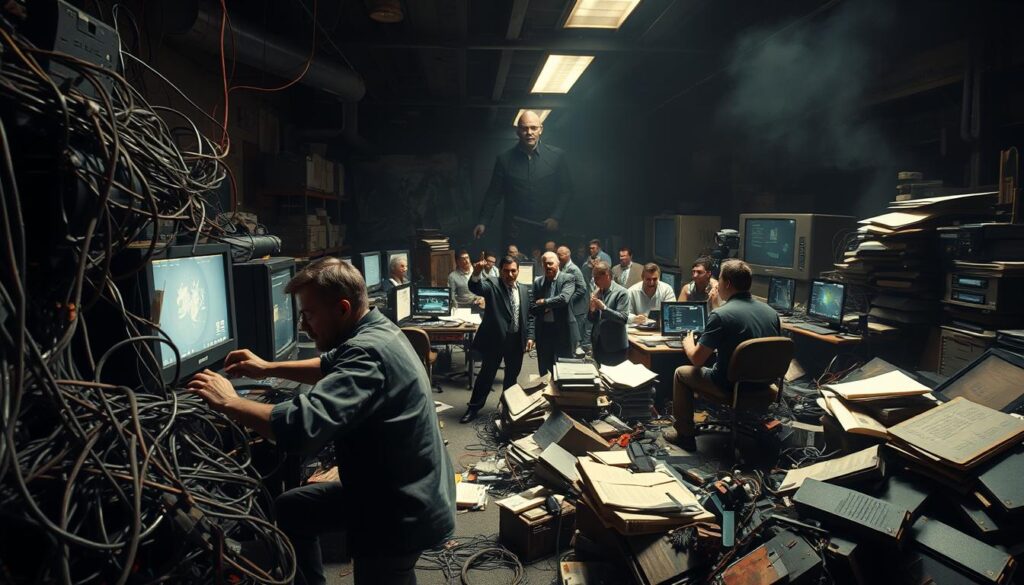
The development spiral was characterized by a cycle of promise and disappointment. Despite the challenges, the development team continued to work towards releasing the game, but the goal seemed to be perpetually out of reach. The period between 2001 and 2006 was marked by significant changes in the game’s development, including shifts in technology and design philosophy.
As the development dragged on, Duke Nukem Forever became synonymous with game development hell. The game’s prolonged development had a lasting impact on the gaming industry, serving as a cautionary tale about the dangers of overly ambitious game development projects.
The story of Duke Nukem Forever’s development during this period is a complex one, marked by both technical challenges and creative vision. Understanding the intricacies of this period is crucial to grasping the full narrative of the game’s troubled history.
Technical Challenges and Engine Changes
The development of Duke Nukem Forever was marred by significant technical challenges. One of the most critical decisions that impacted the game’s development was the change in game engines. Initially, the game was built on the id Tech 2 engine, but as technology advanced, the developers at 3D Realms decided to transition to the more advanced Unreal Engine.
This transition, while necessary for achieving the desired graphical fidelity, significantly delayed the project. The change required a substantial overhaul of the game’s architecture, leading to a considerable setback in the development timeline. The team faced numerous challenges in adapting their existing work to the new engine, including rewriting core components and reworking graphics.
The technical challenges were not limited to the engine change. The team at 3D Realms struggled with optimizing the game for various hardware configurations, a task that became even more daunting after the transition. Later, when Gearbox Software took over the development, they faced similar challenges, including ensuring compatibility with evolving PC hardware standards.
Key technical challenges included:
- Adapting to the Unreal Engine
- Optimizing for diverse hardware configurations
- Reworking graphics and core components
These challenges, while significant, were not insurmountable. The perseverance of the development teams, first at 3D Realms and later at Gearbox Software, ultimately led to the game’s completion, albeit after a prolonged development period.
The experience of Duke Nukem Forever serves as a case study in the complexities of game development, particularly when dealing with major technological shifts. The lessons learned from this project have contributed to the advancement of game development practices in the industry.
The3D Realms Era: Management Issues and Funding Problems
Duke Nukem Forever’s development under 3D Realms was characterized by significant challenges, including managerial strife and financial woes. The period was marked by a series of delays and controversies that would eventually contribute to the game’s “vaporware” status.
During this era, 3D Realms faced numerous internal conflicts and management changes that impacted the game’s development trajectory. The lack of a clear direction and consistent leadership hindered the progress of Duke Nukem Forever.

Funding was another critical issue. The game required substantial resources to meet its ambitious goals, but the financial backing was inconsistent. This led to a stop-start approach to development, further exacerbating the delays.
The table below summarizes some of the key challenges faced during the 3D Realms era:
| Challenge | Description | Impact |
|---|---|---|
| Management Issues | Internal conflicts and leadership changes | Unclear direction, inconsistent decisions |
| Funding Problems | Inconsistent financial backing | Stop-start development, delays |
| Technical Challenges | Difficulty in meeting ambitious game goals | Further delays, increased costs |
These challenges, among others, contributed to Duke Nukem Forever becoming one of the most notable examples of a “vaporware game” in gaming history. The game’s prolonged development and eventual release are often cited as a cautionary tale in the gaming industry.
The legacy of Duke Nukem Forever under 3D Realms serves as a reminder of the complexities and risks involved in game development, highlighting the importance of stable management and adequate funding.
The2009 Collapse:3D Realms Shuts Down
The collapse of 3D Realms in 2009 was a pivotal moment in the longest game development saga – Duke Nukem Forever. After years of development, the shutdown sent the gaming community into a state of uncertainty regarding the game’s future. Duke Nukem Forever was more than just a game; it was a symbol of perseverance and the challenges faced by game developers.
The immediate impact of 3D Realms’ shutdown was felt across the gaming industry. Fans of the Duke Nukem series were left wondering if the game would ever see the light of day. The uncertainty surrounding Duke Nukem Forever’s development was not new, but the closure of the studio that had been working on it for over a decade raised significant doubts.
Key factors leading to the shutdown included:
- Financial difficulties faced by 3D Realms
- Management issues within the company
- The prolonged development cycle of Duke Nukem Forever
The situation was dire, with many believing that the game had become vaporware. However, the story of Duke Nukem Forever was far from over.
Gearbox Software to the Rescue:2010 Acquisition
After years of development hell, Duke Nukem Forever found an unexpected savior in Gearbox Software, which acquired the game’s rights in 2010. This move marked a significant shift in the game’s fortunes, as Gearbox Software took on the challenge of completing a project that had been mired in delays and technical issues.
Gearbox Software, known for its work on the Borderlands series, brought a fresh perspective and new resources to the table. The acquisition not only saved Duke Nukem Forever from potential cancellation but also injected new life into the project. Gearbox’s involvement meant that the game could be re-evaluated and re-developed with modern standards in mind, potentially overcoming the technical hurdles that had plagued its development under 3D Realms.
The transition from 3D Realms to Gearbox Software was not without its challenges. Integrating the existing work into a new development framework required significant effort. However, Gearbox’s expertise in handling complex game development projects proved invaluable. Their approach to reviving Duke Nukem Forever involved a thorough assessment of the game’s current state and a strategic plan to complete it.
By acquiring the rights to Duke Nukem Forever, Gearbox Software demonstrated its commitment to completing the game, despite its troubled history. This move was seen as a positive step by fans and industry observers alike, who were eager to see the game’s development finally come to fruition.
The Final Push to Release:2010-2011
In 2010, Gearbox Software acquired the rights to Duke Nukem Forever, marking the beginning of the end of its development hell. This acquisition was a crucial turning point, as it brought in a developer with the resources and expertise to navigate the game’s complex development challenges.
Under Gearbox Software’s leadership, the development team worked tirelessly to address the numerous issues that had plagued the game for years. One of the significant challenges was optimizing the game’s performance on various hardware configurations. The team implemented several patches and optimizations to ensure a smoother gaming experience.
The final development phase also saw a renewed focus on the game’s marketing strategy. Gearbox Software worked closely with the game’s publishers to create a buzz around the game’s impending release. Despite the delays, the gaming community remained interested, and the anticipation was palpable.
| Development Milestone | Date | Notes |
|---|---|---|
| Gearbox Software Acquires Duke Nukem Forever | 2010 | Marked the beginning of the final development phase |
| Performance Optimizations | 2010-2011 | Significant improvements in game performance |
| Release | June 14, 2011 | The game was finally released after 14 years |
The journey was long and arduous, but with Gearbox Software’s dedication, Duke Nukem Forever was finally ready for release. The efforts put into the final push were instrumental in bringing this highly anticipated game to gamers worldwide.
Release and Reception: The14-Year Wait Ends
Duke Nukem Forever, one of gaming’s most infamous vaporware titles, finally made its debut after years of anticipation and delays.
The game’s release was met with significant scrutiny, with many gamers and critics wondering if it lived up to the hype.
Review Scores and Major Criticisms
Review scores were generally low, with many critics labeling it as an outdated and poorly optimized game. The major criticisms included its weak storyline, poor graphics compared to contemporary games, and numerous bugs.
Disconnect Between Expectations and Reality
There was a significant disconnect between what gamers expected and the final product. The long development time had raised expectations, but the final game failed to deliver on its promised features and quality.
Sales Figures and Publisher Reaction
Despite the negative reception, Duke Nukem Forever managed to sell a considerable number of copies, likely due to the curiosity and nostalgia surrounding the title. The publisher’s reaction was mixed, acknowledging both the commercial success and the critical failure.
Fan Response and Community Reaction
The gaming community was largely disappointed, feeling that the game did not meet the standards set by its predecessor. Fans expressed their dissatisfaction through various online forums and social media platforms.
In conclusion, the release of Duke Nukem Forever was a significant event in gaming history, serving as a cautionary tale about the risks of prolonged game development and the challenges of meeting gamer expectations.
Conclusion: Lessons from Gaming’s Most Notorious Development Hell
The development of Duke Nukem Forever is a cautionary tale in the gaming industry, exemplifying the pitfalls of “game development hell.” As one of the longest game developments in history, it serves as a reminder of the challenges faced by game developers and publishers.
The 14-year wait for Duke Nukem Forever’s release was marred by numerous delays, technical issues, and changes in development teams. Despite the controversies, the game’s release marked a significant milestone for fans who had been eagerly awaiting its arrival.
The Duke Nukem Forever saga offers valuable lessons for the gaming industry, particularly in managing expectations, handling technical challenges, and maintaining a stable development environment. As the industry continues to evolve, understanding the factors that contributed to this “longest game development” can help mitigate similar risks in future projects.
By examining the history of Duke Nukem Forever, developers and publishers can gain insights into the importance of realistic timelines, effective project management, and adaptability in the face of changing technologies and market conditions, ultimately avoiding the trappings of “game development hell.”
FAQ
What was the original release year promised for Duke Nukem Forever?
Why did Duke Nukem Forever take so long to develop?
What role did 3D Realms play in Duke Nukem Forever’s development?
How did Gearbox Software become involved with Duke Nukem Forever?
What were some of the major criticisms of Duke Nukem Forever upon its release?
Is Duke Nukem Forever considered one of the longest games in development history?
What impact did the release of Duke Nukem Forever have on the gaming industry?
What lessons can be learned from Duke Nukem Forever’s development history?
