
Screw Puzzle: Remove Every Bolt with Logic and Smart Planning
Anúncios
Engaging with a Screw Puzzle challenges your brain, demanding strategic foresight.
Every move counts as you carefully unpin plates, watching them drop gracefully into the void below.
Mobile gaming constantly evolves, bringing fresh mechanics to casual players worldwide.
Logic challenges stand out by blending simple controls with increasingly complex scenarios that test your cognitive limits.
Understanding the appeal requires looking beyond the colorful interfaces.
We will explore strategies, psychological benefits, and gameplay mechanics that make these digital brainteasers impossible to put down.
Here is what we cover today. Expect detailed insights into game mechanics, psychological appeal, cognitive benefits, proven strategies, and a comprehensive FAQ section addressing common player queries.

What is the Core Concept Behind a Screw Puzzle?
Developers designed these applications to simulate real-world physics and mechanical interactions.
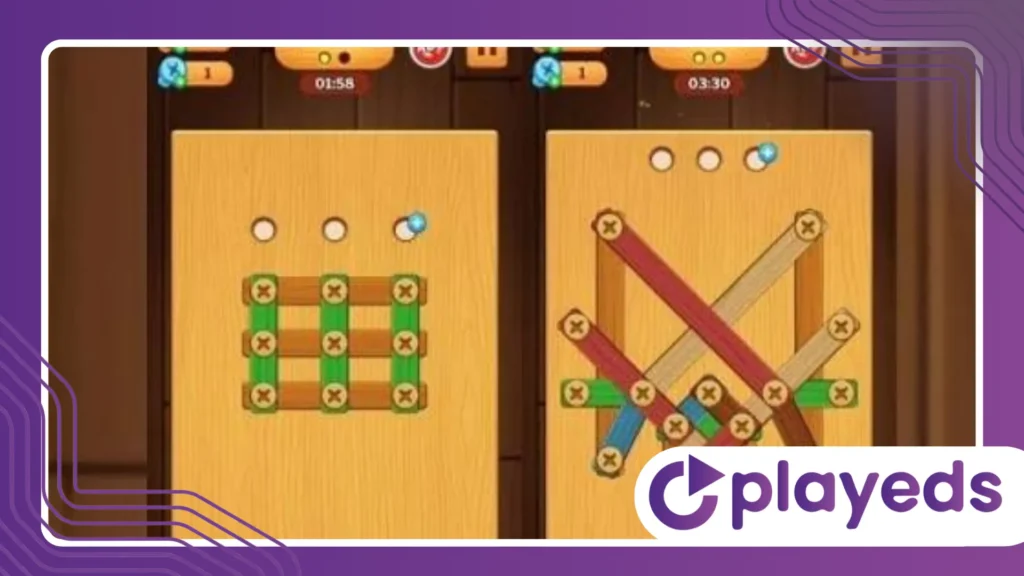
Players tap specific bolts to remove them from a virtual board, freeing trapped wooden or metal objects.
Boards often consist of overlapping planks held together by multiple fasteners.
Releasing one piece might block another hole, requiring careful sequence planning to avoid completely jamming the system.
Early levels introduce basic concepts gently, allowing users to grasp the gravity mechanics. Soon enough, complex layers appear, demanding multiple steps of foresight before making a single move.
Various app stores feature multiple iterations of this genre.
High-quality versions boast realistic sound effects, satisfying visual feedback, and progressively difficult levels that keep users coming back daily.
How Does Physics Impact Your Gameplay Experience?
Gravity acts as your constant companion and primary obstacle.
Dropped planks must fall completely off the screen without snagging on remaining pins or wedging against other structural elements.
Momentum plays a surprising role in advanced stages. Sometimes, letting a heavy metal bar swing creates enough force to dislodge an awkwardly positioned plank blocking your next essential move.
Friction simulation varies slightly between different software versions.
Some studios program wooden boards to slide smoothly, while others incorporate realistic resistance that demands precise timing and angle calculation.
Managing limited empty holes adds another layer of complexity. You must temporarily store removed fasteners in open slots, carefully juggling them around until the path becomes entirely clear.
Spatial awareness becomes crucial as layouts grow denser.
++ Royal Kingdom: Solve Match-3 Challenges While Expanding a Beautiful Fantasy Realm
Visualizing the exact trajectory of falling objects prevents unexpected collisions that instantly halt your progress and force an immediate restart.
Why Do Logic Games Dominate Mobile App Stores?
Casual gamers crave experiences offering quick satisfaction alongside genuine mental stimulation.
Solving a tough Screw Puzzle provides an immediate dopamine rush, rewarding patience and sharp critical thinking skills.
Market data confirms the immense popularity of these brain-training applications.
Millions of daily active users engage with physics-based mechanics, proving our collective desire for accessible intellectual entertainment formats.
During quick breaks or daily commutes, people want digestible entertainment.
These challenges fit perfectly into short timeframes, allowing users to complete one or two stages without heavy time commitments.
Continual updates ensure content remains fresh to maintain user retention rates.
Adding seasonal themes, special timed events, and unique obstacle types prevents the core loop from feeling repetitive.
Analyzing industry metrics reveals exactly how dominant casual logic applications have become.
Read more: Stumble Guys: Run, Jump, and Survive Wacky Multiplayer Challenges
Recent figures highlight massive revenue growth and staggering global download numbers across major mobile storefronts.
| Metric | 2026 Estimated Value | Target Audience |
| Global Puzzle Game Revenue | $12.5 Billion | Casual Gamers |
| Average Daily Playtime | 35 Minutes | Adults 25-45 |
| Monthly Active Users (MAU) | 850 Million | All Demographics |
Such robust statistics demonstrate a clear cultural shift. Modern consumers actively seek out interactive media that exercises their brains rather than just consuming passive video content online continuously.
Which Cognitive Skills Can You Develop by Playing?
Tackling intricate board layouts directly enhances problem-solving capabilities.
Finding the correct extraction sequence forces your brain to evaluate multiple future scenarios before committing to a final physical action.
Scientific research into video games highlights significant benefits regarding pattern recognition.
Recognizing familiar structural traps allows veteran players to navigate complicated stages much faster than absolute beginners ever could.
Exploring the cognitive benefits of puzzle games shows measurable improvements in short-term memory.
Retaining the sequence of planned moves exercises vital neural pathways responsible for everyday information retention.
Patience naturally increases as you encounter increasingly stubborn level designs.
Rushing through a stage almost always guarantees failure, teaching players the distinct value of methodical, deliberate decision-making.
Fine motor skills also receive a mild but consistent workout.
Tapping precise points on smaller smartphone screens requires accuracy, especially when dealing with densely packed virtual hardware elements.
What Are the Most Effective Strategies for Beginners?
Start by identifying the bottom-most supported items.
Releasing structural foundations first often clears large sections effortlessly, giving you more maneuverability for dealing with the complicated top layers.
Always locate your available empty holes before initiating any sequence.
A great Screw Puzzle session turns into a frustrating dead end if you run out of temporary storage space.
Pay close attention to overlapping elements. If a blue wooden plank rests heavily over a red metal bar, the blue piece must absolutely fall first to ensure complete success.
Avoid panicking when an object swings unpredictably.
++ Basketball Zero: Build Your Dream Team and Dominate Every Online Match
Wait for the physics engine to settle completely before making another move, as unexpected momentum can block your only remaining exit route.
Utilize undo features sparingly to maximize your actual learning process.
Making mistakes teaches you far more about structural integrity than simply erasing every minor error immediately after it happens.
When Should You Use In-Game Power-Ups?
Many applications provide tools to bypass incredibly frustrating moments.
Drills, bombs, or extra holes become available as you progress, offering lifelines during seemingly impossible virtual board configurations.
Save these precious resources for the absolute highest difficulty tiers.
Wasting a vital drill on an early stage leaves you completely helpless when facing truly diabolical end-game designs later.
Earning power-ups usually requires watching advertisements or spending real currency.
Managing your digital inventory wisely ensures smooth progression without draining your wallet or testing your patience with commercials.
How Does Sound Design Elevate the Experience?
Auditory feedback provides immense psychological satisfaction.
Hearing a metallic clink or the deep thud of dropping wood triggers positive reinforcement pathways, making every successful maneuver feel uniquely rewarding.
Crisp sound effects also communicate critical gameplay information.
A soft scraping noise might indicate that a piece remains slightly jammed, warning you to adjust your approach before proceeding further.
Background music generally remains unobtrusive and relaxing.
Studios intentionally choose ambient tracks to maintain focus, preventing audio fatigue during extended periods of intense concentration and strategic logic planning.
Conclusion
Mastering any complex Screw Puzzle demands time, spatial awareness, and endless logic.
We see clearly why these physics-based brainteasers capture the attention of casual mobile users everywhere today.
Escaping digital boredom has never looked quite so engaging or mechanically sound.
Every new level brings fresh tests of intellect, pushing players to rethink their basic assumptions about gravity.
Embracing these digital challenges provides genuine intellectual rewards.
Combining simple touch controls with deep structural physics creates an enduring entertainment format that continues dominating global app store charts entirely.
Tracking current mobile gaming industry trends confirms this genre will stick around.
Creators will undoubtedly introduce fresh twists, ensuring our brains stay happily challenged for years to come.
Frequently Asked Questions
What happens if I completely run out of holes?
Running out of open slots creates a structural jam. You must restart the level or use a specific booster to continue playing without issues.
Can I play a Screw Puzzle without an internet connection?
Most major versions allow offline play perfectly. However, viewing optional advertisements for bonus items requires an active data connection constantly.
Are these logic games suitable for children?
Absolutely, they provide excellent problem-solving practice in a safe environment. Parents often encourage this type of play to boost spatial reasoning in developing kids.
Why do some levels feel mathematically impossible to solve?
Game designers occasionally build tricky trap levels. Finding the solution requires breaking away from obvious patterns and experimenting with highly unconventional removal sequences to succeed ultimately.
Will there be a sequel to the current top Screw Puzzle?
Constant updates fuel the market rather than standalone sequels. Studios add new content packs regularly, keeping the original application entirely fresh and highly relevant today.
++ Wood Nuts and Bolts Screw Puzzle Sort Game
