Anúncios
Whether you are diving into the latest sim-racing release or analyzing the strategic depth of modern stock car competition in NASCAR 26, raw horsepower will only carry a driver through the opening laps.
Winning a stock car championship rarely comes down to raw speed alone.
Long-run tire degradation, fuel-saving windows, aerodynamic drafting, and split-second pit road decisions separate mid-pack finishers from series champions.
For players and racing fans looking to elevate their race craft, understanding how track geometry interacts with car setup and race-day strategy is essential.
Because official developer patch notes and specific career-mode mechanics for video game releases can shift with seasonal updates, the strategic principles below focus on verified stock car racing dynamics, telemetry fundamentals, and proven championship management frameworks used across modern NASCAR simulation titles.
Key Takeaways
- Tire management dictates long-run pace: Pushing at 100% throttle during the opening ten laps of a green-flag run burns off right-side rubber, costing multiple seconds per lap late in a stage.
- Track-type specialization wins playoffs: Short tracks, intermediates, superspeedways, and road courses require fundamentally different braking points, gear ratios, and pit strategies.
- Stage points are the safety net of the championship format: Securing top-ten finishes in Stages 1 and 2 builds a crucial playoff point buffer that protects against late-race wrecks.
- Fuel-mileage gambling requires telemetry discipline: Short-pitting or stretching a fuel window works only when paired with smooth throttle modulation and strategic drafting.
- Car setup adjustments should target balance, not just top speed: Fixing tight or loose handling conditions through wedge, track bar, and tire pressure tweaks yields faster, more consistent lap times than chasing straight-line velocity.
How Does Race Strategy Shape Success in NASCAR 26?
In modern stock car racing, a race is broken into three distinct segments: Stage 1, Stage 2, and the Final Stage.
Approaching a race in NASCAR 26 as a single continuous sprint leads to worn-out tires, missed pit windows, and unnecessary on-track collisions.
Instead, successful drivers treat each stage as an independent mini-race with its own tactical goals.
During the first two stages, the primary objective is earning stage points while keeping the race car clean.
Finishing inside the top ten at the end of a stage awards valuable championship points, and winning a stage grants a playoff point that carries forward through the postseason rounds.
However, chasing a single extra stage point by making an aggressive three-wide dive on the final lap of Stage 1 often leads to sheet-metal damage that ruins aerodynamic efficiency for the remainder of the event.
When the final stage begins, strategy shifts entirely toward track position and tire life.
Caution flags frequently bunch the field up with fewer than twenty laps remaining.
Having a fresh set of tires saved in the pit box—or knowing when to take two right-side tires instead of a full four-tire stop—often decides who controls the front row on the decisive late-race restart.
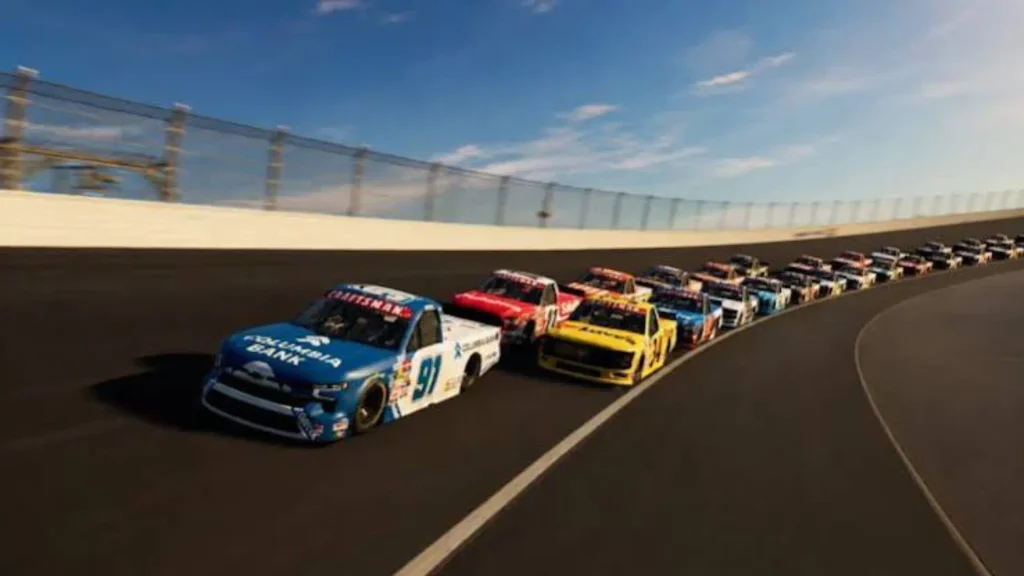
Mastering Different Track Types and Aerodynamics
A championship schedule tests versatility across four distinct circuit categories. Each track style demands a tailored driving technique and mechanical approach.
| Track Category | Primary Strategic Focus | Key Driving Technique | Typical Pit Priority |
| Superspeedways (e.g., Daytona, Talladega) | Drafting packs, fuel saving, wreck avoidance | Smooth steering inputs, maintaining bumper energy | Fuel-only stops during green-flag cycles |
| Intermediate Ovals (e.g., Charlotte, Kansas, Las Vegas) | Aerodynamic grip, multi-groove lane searching | Trail braking into turns, rolling center-corner speed | Four tires and fuel to combat heavy right-side wear |
| Short Tracks (e.g., Bristol, Martinsville, Richmond) | Brake cooling, track position, bumper etiquette | Heavy straight-line braking, early throttle exit | Two right-side tires or chassis adjustments |
| Road Courses (e.g., Watkins Glen, Sonoma, COTA) | Braking zones, curb management, pit window timing | Downshift rev-matching, maximizing exit traction | Short-pitting before caution flags to gain track position |
Superspeedway Drafting and Pack Racing
On high-banked superspeedways, individual lap speed matters far less than aerodynamic cooperation.
++ EA Sports College Football 27: Lead Your Team to Playoff Glory
Cars running in a tight single-file or double-file draft punch a larger hole through the air, reducing drag and allowing the pack to reach speeds well above 190 miles per hour.
To survive and win on superspeedways, focus on the following habits:
Manage your runs carefully: When you get a strong aerodynamic push from the car behind you, avoid making sudden, jerky lane changes that break the draft or trigger multi-car accidents.
Save fuel under green: Running at 85% to 90% throttle while tucked behind a lead car keeps you locked in the draft while burning noticeably less fuel, allowing you to spend less time on pit road during green-flag stops.
Read more: Basketball Showdown: Master Perfect Shots and Climb the Global Rankings
Position yourself before the white flag: Making a winning move on the final lap requires lining up a drafting partner two to three laps prior, rather than pulling out of line alone with no momentum behind you.
Intermediate Ovals and Multi-Groove Racing
Mile-and-a-half intermediate tracks represent the backbone of the schedule. On these circuits, aerodynamic downforce and tire fall-off dictate the flow of every run.
Early in a stint, the bottom groove next to the apron usually offers the shortest and fastest line around the track.
As rubber builds up on the asphalt and tires lose grip, the fastest lane often migrates toward the middle or the high groove right against the outside retaining wall.
++ June’s Journey: Search Hidden Objects and Solve Intriguing Mysteries
Drivers who adapt their line as the track evolves maintain consistent lap times while competitors stuck on the bottom slide up the track and lose momentum.
Short Tracks and Road Courses
Short tracks compress the entire field onto half-mile or three-quarter-mile ovals where lap traffic becomes a constant obstacle within fifteen laps of a restart.
Patience is critical. Overdriving corner entry overheats the front brakes and causes the front tires to push toward the wall.
Focus on braking in a straight line, rotating the car smoothly through the center of the corner, and squaring off the exit so you can apply full throttle earlier than the car alongside you.
Road courses flip traditional oval habits upside down. Heavy stock cars require long braking distances into sharp hairpin turns and chicanes.
Because road courses feature long lap times, pit strategy frequently revolves around flipping the stage—pitting two or three laps before a stage ends to sacrifice stage points in exchange for cycling to the front of the field when the leaders pit during the stage break.
How Should You Manage Tire Wear and Fuel Windows?
Tire degradation is the single biggest differentiator between casual racers and championship contenders. Every time you slide the rear tires on corner exit or scrub the front tires by turning the steering wheel too sharply mid-corner, surface temperatures spike. Excessive heat accelerates rubber wear and permanently reduces mechanical grip for the rest of the stint.
To extend tire life over a long green-flag run:
Ease into the throttle: Roll onto the accelerator smoothly rather than stabbing the pedal to the floor at the apex.
Reduce steering angle: If the car is tight in the center of the turn, adding more steering input only shreds the left-front tire; instead, lift slightly off the throttle to let the nose bite.
Watch your entry speed: Backing up your braking point by just half a car length keeps the tires cool and often produces a faster exit speed down the straightaway.
Fuel management works hand in hand with tire conservation.
When a race approaches a potential fuel-mileage finish, coasting into the braking zones—lifting off the throttle a few hundred yards before hitting the brakes—saves measurable fuel without sacrificing substantial lap time.
Using higher gears under caution laps also stretches fuel reserves, ensuring you can stay out while rivals are forced to make splash-and-go pit stops.
Car Setup Fundamentals: Fixing Tight and Loose Handling
Even with strong driving habits, an unbalanced car setup will hold back your lap times.
In stock car terminology, handling issues fall into two main categories: tight (understeer, where the front tires lose grip and the car pushes toward the outside wall) and loose (oversteer, where the rear tires lose grip and the back end tries to spin out).
Before making complex suspension changes, use these foundational adjustments during pit stops or garage sessions:
Wedge (Cross-Weight): Adding positive wedge increases weight on the right-front and left-rear tires, making the car tighter.
Decreasing wedge frees up the car, helping it turn better through the center of the corner.
Track Bar Height: Raising the track bar shifts the rear roll center upward, freeing up the rear end to cure a tight condition.
Lowering the track bar plants the rear tires for more stability when the car feels loose.
Tire Pressures: Lowering air pressure increases the tire’s contact patch with the track surface, adding mechanical grip on that end of the car, though extremely low pressures can slow down straight-line speed and increase tire heat.
Tape on the Grille: Adding grille tape increases front aerodynamic downforce and reduces drag, which helps cure a tight car on corner entry.
However, too much tape restricts airflow to the radiator and will cause the engine to overheat during long runs.
Make only one adjustment at a time during practice sessions, run five to ten clean laps to evaluate the change, and check tire temperatures across the inside, middle, and outside edges to verify that the tires are wearing evenly.
Navigating the Championship Playoff Format
Winning the title requires peaking at the right time across the elimination-style postseason. In the standard playoff structure, sixteen drivers qualify based on regular-season race wins and accumulated championship points.
The postseason then unfolds across multiple three-race elimination rounds, culminating in a single championship-deciding race among the final four contenders.
Consistency matters early, but execution under pressure defines the playoffs:
Bank playoff points during the regular season: Every race win and stage victory adds bonus points that carry over into each elimination round.
A cushion of twenty or thirty playoff points can save your season if you suffer a mechanical failure or get caught in an unavoidable wreck.
Respect the cutline: In the final race of an elimination round, check the live points standings before making high-risk moves.
If you are comfortably above the elimination cutline, settling for a safe eighth-place finish is far smarter than risking a crash while battling for fourth.
Prepare specifically for the championship finale: Identify the track hosting the final race on your schedule early in the season.
Dedicate extra practice time to perfecting your long-run setup and pit road entry speed at that specific venue so you are ready if you reach the Championship 4.
For official rules, point structures, and real-world series regulations that inspire modern NASCAR simulations, consult the official NASCAR rulebook and news hub and the International Motor Sports Association (IMSA) technical resources for broader stock car and road-racing engineering standards.
Conclusion
Chasing a championship in NASCAR 26 rewards discipline, adaptability, and smart race management over reckless aggression.
By treating each stage with a clear strategic purpose, conserving tire grip over long green-flag runs, and making targeted chassis adjustments to keep your car balanced, you put yourself in position to capitalize when late-race cautions fly.
Start your next race weekend by focusing on smooth throttle inputs and clean pit road execution—those small habits compound over a full season into championship-winning speed.
Frequently Asked Questions
How do I stop burning up my right-front tire in NASCAR 26?
Burning up the right-front tire usually happens when you enter corners too fast and turn the steering wheel excessively to force the car down to the bottom groove.
Brake slightly earlier in a straight line, let the car roll smoothly into the apex without forcing the wheel, and avoid accelerating hard until the car is pointed straight toward the exit.
When is the best time to pit during a green-flag run?
On tracks with high tire wear, pitting near the middle of the fuel window—often called short-pitting—gives you fresh tires that can gain two to three seconds per lap over competitors staying out on worn rubber.
However, if a caution flag comes out before the rest of the field pits, you risk getting trapped a lap down, so weigh track position against tire fall-off before committing to pit road.
Should I use a loose or tight car setup for long races?
A slightly tight setup is generally safer and easier to manage over a full race distance, especially on restarts and in heavy traffic.
As fuel burns off and tires wear down during a stint, most stock cars naturally become looser, so starting slightly tight helps the car settle into an ideal neutral balance during the final laps of a run.
What is the fastest way to improve lap times without changing car setups?
Focus on your braking zones and corner exits rather than trying to carry extreme speed into the turns.
Braking smoothly at a consistent visual marker, hitting the inside apex cleanly, and applying steady, progressive throttle off the corner will immediately shave tenths of a second off your lap times while keeping your tires cooler.
++ The Chase 101: How NASCAR’s new championship format works